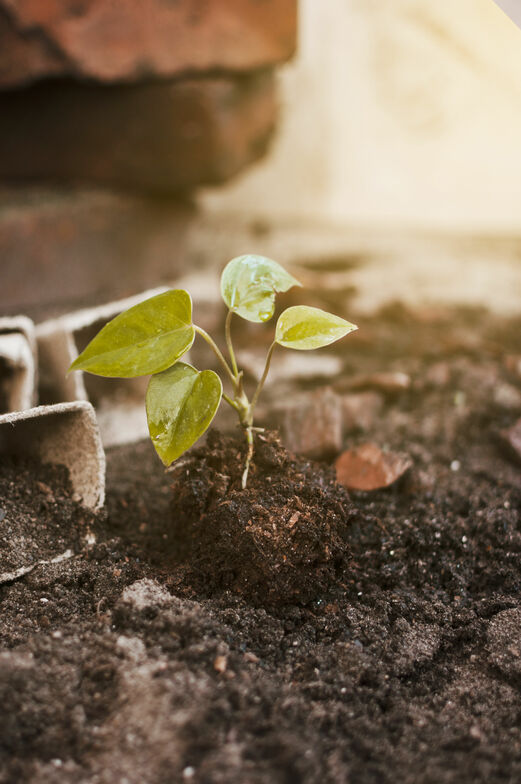
Parable of the Sower/Soil Message Feb. 8, 2026
This parable of the sower is probably as familiar to you as it is to me. I’ve heard it
numerous times over the years. Recently, I gained some new insights into and
some practical applications of it. With humility, I would like to share them with
you.
I’ve often wondered what type of soil my spiritual life represents. In the past,
looking at my life in kind of an overall view, I’ve felt that I basically had ‘good soil.’
Being a Preacher’s Kid, I grew up in the church, loving the church and the word of
God. But when I look more carefully, with a smaller lens, I see my arrogance and
self-righteousness in being comfortable thinking that I have been “good soil.” In
truth, I have frequently put off time to read and study God’s word. Sometimes my
desire to grow in God’s word has not really been my top priority.
I read this quote online from a sermon on this parable by Richard Sipes, from the
New Covenant Baptist Church,
“If we are not careful, we that are saved can allow ourselves to develop the wrong
kind of heart. We can become hard-hearted toward the things of God, toward His
house and toward His word…We find ourselves fruitless and defeated as a
believer, or we can grow shallow in our commitment to the Lord, or we might
allow our lives to become filled with thorns or worldliness.”
My self-reflection gave me the insight that the condition of the soil of my heart
was not, and is not, always receptive to the word of God.
I feel the most significant insight to me came from the gospel of John. John 1: 1 &
2 says:
"The Word was with God, and the Word was God. He was with God in the
beginning.”
Since in this parable, the seed is referred to as the word, Jesus is referred to as
“The Word,” I broadened my application of this parable to refer not only to
receptivity of God’s word in scripture, but also to my relationship with Jesus.
Maybe you have already thought of this… but it was new to me to think of “The
Word” in the parable as being Jesus himself. A quote I found in my research
about the Parable of the Sower says:
“Theologians suggest Jesus is sowing himself into the hearts of those prepared to
receive him. In this context, the ‘word’ is not merely information, but the active,
living presence of Christ entering a person’s life to produce spiritual growth.”
In the Daily Prayer book by John Baillie, one prayer uses the phrase, “…the
indwelling of Christ in my soul,” and in another prayer, he asks that “Jesus may be
more deeply rooted within me.” We are encouraged to feel Jesus living in our
souls.
I think we can view the types of soil as different levels of receptivity to Jesus.
--I asked myself: Have I become set in my ways and habits, so that I have become
hardened to the Word and to Jesus? Is my relationship with Jesus being choked
out by worldly concerns, so that my relationship with Him is not a top priority? Is
my relationship with Jesus on rocky soil-- is it just a shallow relationship with no
deep roots? Is my relationship with Jesus at times meaningful and a source of joy,
but is that joy and passion fleeting and short-lived?
I also reflected on my response to Jesus every day, on a daily basis. I analyzed my
spiritual relationships with a sense of urgency and immediacy. What is the
condition of the ‘soil of my heart,’ RIGHT NOW, TODAY? Am I open today to
accept the seed of God’s word in the Bible, to not only hear it but to understand
it? Am I today working on a deep relationship with Jesus, the Living Word of God?
In the Bible the heart is viewed not just as the center of emotions but also as the
center of our understanding and our volition – where we think, feel and choose.
It is OUR CHOICE what kind of relationship we will have with God, with Jesus,
TODAY. You and I need to daily make a deliberate choice to have healthy, ‘good
soil.’ We cannot think that because we made the choice years ago to follow Christ
that we are automatically being receptive to the seed and to his word.
So how can I, how can we, cultivate the soil of our hearts and minds to prepare to
receive the seed, so that we can grow and be productive, so that we can have a
deeply rooted relationship with Jesus and so that we can bear fruit? How can we
‘loosen up’ our soil, remove the rocks, thorns and other debris, and add what’s
necessary to improve the quality of our spiritual soil?
There are a few ways: First, we need to loosen up the hard soil of our minds by
being still, by meditating, so that we can be open and receptive to God’s still small
voice. In a devotional I read recently, the author states,
“Take time to be holy. The word holy does not mean goody-goody; it means ‘set
apart for sacred use.’ That is what quiet moments in God’s presence are
accomplishing within us. As we focus our minds and hearts on God, on Jesus and
on the Holy Spirit we are being transformed; we are being re-created into the ones
he designed us to be. This process requires blocks of time set aside for
communication with God.”
The hymn “Take Time to be Holy,” was written in the 1800’s by William Longstaff
after he had heard a sermon based on 1 Peter 1:15-16. That verse says:
“But just as he who called you is holy, so be holy in all you do; for it is written,
“Be holy, because I am holy.”
The author of this hymn chose to focus on practical advice for “cultivating
holiness,” urging us to --pray often, abide in God always, focus on His word, let
God be our guide, look to Jesus, trust in His word, spend much time in secret with
Jesus, be calm in our souls as we surrender each thought and motive to God.
These ways are time-proven, they are still relevant and appropriate for us today.
Jesus explains that the good soil stands for those who HEAR. We cannot hear
when we are in constant activity with continual noise surrounding us. T.S. Eliot
says in a quote from “Ash Wednesday” –
“Teach us to care and not to care. Teach us to sit still.”
Still another way we can loosen our soil is to analyze our spiritual habits—have
become rutted in old habits, allowing our hearts to harden like the soil on a well-
traveled path? Jesus said that the good soil represents those who hear and
UNDERSTAND. We can prepare ourselves for The Word by reading, studying, and
researching Biblical passages. A wealth of information is at our fingertips,
available and accessible, but it takes a deliberate choice and effort. Have we
matured and grown in our understanding of The Word, or are we at the same
place of understanding that we were 5 years ago, or 2 years ago, or a year ago? If
we aren’t learning new things, gaining new insights and understanding, then we
have become stagnant – hardened to the Word.
Maybe some of you have this same challenge: my heart and mind can be classified
as all the types of soil within the same day! I can start out the day feeling closely
connected to God, with all the best intentions, then the busyness and cares of the
day get in the way, choking out my awareness of God’s presence and spirit. How
can we be receptive to The Word all throughout the day? I am trying to adopt
small habits to stay spiritually awake and aware throughout the day: I
intentionally look for “God Sightings,” being aware of the divine in the ordinary
such as a gentle breeze or a powerful gust of wind, the warmth of sunlight, hearing
beautiful music, or seeing a beautiful smile on a stranger. These are reminders of
God’s presence, his goodness and his creation. This shift in thinking makes my
own cares seem small -- and, it’s crucial to follow-up with a prayer of thanks for
those small blessings. It has been said that the best way to connect with God is
to say a prayer of thanks.
We can prepare ourselves for His Word by acknowledging that the seed of God’s
word, is LIVING. In the Old Testament, God is referred to as the ‘Living God.’ In
the New Testament, Jesus is called the ‘Living Water,’ the ‘Living Bread,’ the ‘Living
Sacrifice,’ and the ‘Living Word.’ We know that living things grow, become more
mature; they need daily care and attention, they cannot be totally ignored, they
thrive when treated with love. We know that ROUTINES are important in caring
for living things, to ensure consistent care. We can view our relationship with God
as a living thing, realizing that it needs regular care, and needs to be part of our
daily routine. Richard Sipes says,
“An attitude of openness to God will not be accomplished overnight, but will more
likely take the form of an ongoing cycle of preparation…Just as a garden requires
constant care in order to yield a bountiful harvest, so too our souls need constant
tending if we are to yield fruit for the kingdom of God.”
A quote I saw recently when driving:
“The road to success is always under construction.”
Having “good spiritual soil,” having a deep, close relationship with Jesus, requires
our continual work and attention.
We all invest time and care in our loved ones and often put a lot of time and care
into other living things such as our pets, our plants and gardens. We discipline
ourselves to give the necessary time for those living things to thrive, and we
receive fulfillment and joy back from them. Shouldn’t we treat our spirituality,
our relationship with Christ, with at least as much time, love and care as we do a
family member? We are promised great joy now and in heaven if we have our
priorities right.
A final step of this process of readying our soil so that we can be fruitful is
explained by Jameson Steward in a message entitled, “Are You a Living Sacrifice to
God?” Jameson explains that while in the Old Testament sacrifices were dead,
burnt offerings, in the New Testament Jesus became the Living Sacrifice. The
sacrificial system was changed, bringing a new covenant where obedience and a
transformed life replace the physical offerings of the Old Testament.
As Christians aiming to be like Christ, Steward says,
“We need to offer our entire lives to God on a daily basis – transformed by his
mercy and dedicating our thoughts, our actions and our desires to God as a
response to Christ’s sacrifice. We, too, are called to be Living Sacrifices.”
I think that we can look at cultivating the soil of our hearts as a preliminary step to
being transformed and becoming living sacrifices. When we cultivate the soil of
our hearts to receive God’s word, we are readying ourselves for the Holy Spirit to
transform us into who God wants us to be. By allowing ourselves to be
transformed and changed we are becoming living sacrifices. By giving up and
offering to God our pride, our busyness and shallow spiritual lives, we can be ready
to receive the Living Word. God will provide the growth and promised fruit of that
seed.
Rom. 12:2 – “Do not be conformed to this world, but be transformed by the
renewal of your mind…”
2 Corin. 5:17 – “Therefore, if anyone is in Christ, he is a new creation. The old has
passed away; behold, the new has come.”
There is a sense of urgency to this preparation of the soil of our hearts. The Bible
often mentions not putting things off. The parable of the 10 virgins with oil
lanterns in Matt. 25:1-13 is an example of Jesus teaching us to be prepared – to
have our hearts and minds focused on the right thing and to be prepared for His
second coming. An online summary of the parable says,
“We need to be spiritually prepared for the return of Christ. The ‘oil’ cannot be
shared with other Christians, but each of us must maintain our own spiritual life.”
Other verses warning us are,
Ephes. 5:15-16 – “Be very careful, then how you live, not as unwise but as wise,
making the most of every opportunity…”
Heb. 2:1 – “We must pay the most careful attention, therefore, to what we have
heard, so that we do not drift away.”
A devotional I read recently states that --
“to be close to Christ we must live in the present moment. That this is where we
can encounter and enjoy God’s presence.”
We must take the time TODAY, NOW.
In closing, the hardened soil on the path in the parable represents a hardened
mind, a hardened heart. Employing the same methods of worship, the same
devotional routines, and the same spiritual thought patterns, might cause us to
become hardened in our ways. Or have we become hardened by our self-
reliance, our independence & pride—have we have drifted away from needing
God? We can loosen the hard soil of our hearts and minds by working on being
HUMBLE, by having a desire to learn, to grow, to change -- we need to be
teachable.
The rocky soil, allowing only shallow roots, represents our shallow and superficial
relationship with Jesus and God’s Word. Do we have a deep, meaningful
relationship with Jesus? Is our relationship changing and growing or is it the same
as it’s been for years? Is our relationship just ‘on the surface,’ where we know
ABOUT Jesus but don’t really have a close connection with Him? A daily
meditation posed this thought,
“It is much easier to read a Biblical text as a piece of poetry/literature—left by an
ancient teacher. But Jesus is not only giving us his teaching, he is giving us himself
as ‘the way and the truth and the life.’”
Are we reading/hearing/studying scripture because it is a source of good
instruction and wisdom for life? Or are we reading the Bible with heartfelt intent
of growing closer and feeling the presence of God?
What are the rocks and obstacles that prevent us from having a deep and close
relationship with Him? We need to get rid of the rocks of self-will and self-reliance
and be open to hearing God’s will.
Thorny soil represents a life with many distractions and responsibilities choking
out our desire to spend time with the Lord. How many of our thoughts are
worries? We all have concerns and anxieties about all the uncertainties we face, --
with our finances and our health, about the futures of our children and
grandchildren, the future of our country, our churches. The thorny soil represents
a cluttered mind—we need to shift our focus from all the uncertainties, all the
‘what ifs’, all the possible scenarios… and FOCUS on God and so that our
relationship with Him can grow.
As our spiritual soil is cultivated and imporoved, I believe that we will experience
the transformation of our hearts and minds by the Holy Spirit. Our roots in
Christ will then deepen and we will bear fruit.
We need to REFLECT on the condition of our spiritual soil;
We need to REPENT to REMOVE our sins, our distractions, our misplaced priorities,
the rocks and thorns of our soil;
We need to be RENEWED and REMADE daily by the transformation of our minds
through the Holy Spirit.
I pray and hope that we will all continue to work at becoming “good soil,” realizing
it is a daily choice to not have a hardened heart and mind, a choice to not let God’s
Word and a relationship with Jesus become choked out by other concerns. I pray
that the seed will grow and mature in each of us so that we can be prepared,that the seed will grow and mature in each of us so that we can be prepared,
productive and fruitful in our Christian lives.