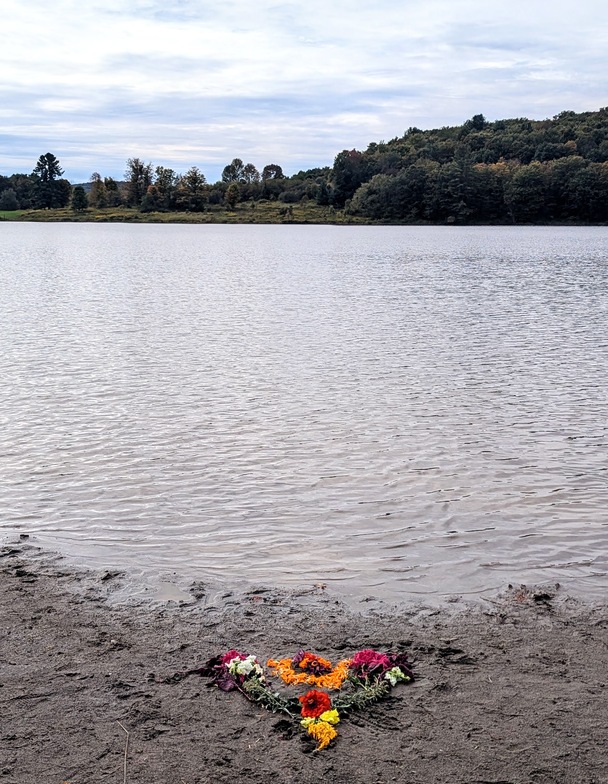
“In the Beginning Was the Conversation”
A sermon preached by Rev. Sarah Henkel at Otisville-Mt. Hope Presbyterian Church, September 27, 2026
Scripture Text: John 1:1-5
In the first year of Covid, in the midst of so much loss and uncertainty, there was a gift that emerged in the intentional community I was a part of and I wonder if any of you had a similar experience. The gift was: We spent way more time outside. Even when it got to be bitter cold, we bundled up to be outside together, to talk in the open air, distanced across warm fires. We had a birthday parade among the bare trees in late December. We picnicked throughout the spring. We set up outdoor movie screenings in all seasons. The impulse to be outdoors was, at least initially, to be in the presence of other humans. But the company of trees, birds, the touch of cool water…that company grew to be equally comforting and more fully included in what we defined as our ‘community.’ Around that time - because of Covid disruptions to work and housing - our family ended up having to leave that community - the people, trees, deer, and lakes we loved. By the grace of God - and Ann and Edgar - we ended up relocating to Middletown, NY where we were welcomed home on the land of Freedom Farm Community. I often associate books I read with the place where I read them and I remember picking up a copy of the newly published book, Church of the Wild: How Nature Invites Us Into the Sacred by Victoria Loorz and reading it beside the gardens at Freedom Farm. There was much in this book that touched and transformed me but perhaps nothing more so than her notes on this morning’s scripture from the beginning of John’s gospel. Victoria shares her discovery of a much older translation of the Greek word, logos, than the translation - Word - used in today’s text, which begins ‘In the beginning was the Logos, the Word.’ Victoria writes in Church of the Wild that, “Up until the fourth century…theologians and bishops and translators consistently translated the Greek word logos into Latin, the language of the church, as sermo, which means not ‘word’ but ‘conversation.’” (p. 109) I want to pause here and ask you to describe ‘conversation’? And maybe not just any conversation but what are the characteristics of good conversation? -Interest, listening, attention, good questions, sharing your own thoughts and inviting the other person to share theirs, gratitude, thanks. Let this new old translation of John 1:1-5 resonate in your heart for a moment: “In the beginning was the Conversation, and the Conversation was with God, and the Conversation was God. The Conversation was with God in the beginning. Everything came into being through the Conversation, and without the Conversation not one thing came into being that came into being. What has come into being in the Conversation was life, and that life was the light of all people. The light shines in the bleakness, and the bleakness did not overtake it.” If we were to characterize the bleakness we are facing right now with one metaphor, the breakdown of conversation might serve well…and perhaps not very metaphorically! Loorz describes the root verb of conversation as ‘the act of living with.’ The bleakness takes shape in the forces pushing towards violent acts of living without one another, violence that categorizes life hierarchically, that severs so many from the basic needs for survival. These forces enact real violence but they are built on a lie: the lie of separation. We are as Rev. Dr. Martin Luther King, Jr. described it, “caught in an inescapable network of mutuality, tied in a single garment of destiny. Whatever affects one directly affects all indirectly.” This reality of interconnectedness is especially clear, starkly clear, when we remember our other-than-human neighbors in creation are in the Conversation. We quite literally cannot live without the trees, without their air that breathes us. We cannot live without the water that courses through our bodies same as it flows down the Walkill River. When I read about this new old translation of the Word as the Conversation in the Church of the Wild book I felt called with others in my community to deepen our practice of conversation with trees, water, animals, and plants. And, pretty quickly, I realized how awkward, unprepared, and - to be honest - ashamed I felt about being in conversation with non-human neighbors. There is little in the dominant culture that instructs or prepares us for meaningful dialogue with creation. We are primarily taught that nature, while full of scientific wonders, is there for our benefit, for the extraction of resources. In the history of this nation, the Indigenous people who have stood up for the sacred rights of the water, soil, and trees were dismissed as foolish and, far worse, were violently attacked and killed along with the land they sought to protect. It - which is the pronoun we use for most of creation, except for humans - is often made invisible even while sustaining our every breath and nourishment. We, of course, struggle to converse with what we don’t even notice is there. But Jesus calls us back into Conversation with ALL of creation. When we look at the Gospel texts we see that Jesus was in constant conversation with creation. He spent 40 days among the wild animals and flowering succulents of the desert. Whenever Jesus took off from the often frustrating disciples where could he be found? By the water or on a mountaintop or in a garden. Jesus’ parables focus on seeds, soil, birds, weeds, goats, and agricultural workers. Jesus commands us: be like birds of the air! Look at the lilies of the field! Jesus - by the example of his own life - is calling us into a relationship and into conversation with creation. How do you, how do we converse with the others in creation whose names and languages we do not yet know? In one of the last poems she wrote before dying, Mary Oliver shared these ‘Instructions for living a life’ that provide guidance as we hold this question and seek to deepen the sacred conversation, she writes: Pay attention. Be astonished. Tell about it. I’ll close with two invitations in which you might practice Mary Oliver’s advice in community with creation and one another: The first is an invitation to Freedom Farm Community in Middletown, NY where we are gathering the last Sunday of every month outdoors at 3 p.m. for prayer in conversation with all of creation. We call these gatherings Compost Collective gatherings because - over the years - we have received so much wisdom via the life that emerges from the decay of the compost pile. The agenda for our time together is very open and focused primarily on practicing the listening piece of Conversation. We carve out intentional time for our relationship with other members of creation mindful of theologian Sallie McFague’s reminder, “We will not save what we do not love, and we cannot love what we do not know.” The second invitation is to begin a conversation with one another with a prompt that Victoria Loorz shares in Church of the Wild. Ask another person to tell you about the land that raised them. And then listen. Your ears will be opened to the sustaining presence of creation that God put us in conversation with from our very first breath. In the Conversation between one another, between the person sharing and the land that raised them, life is born among us. Life that is the light of the world in the bleakness that we face.This is the invitation of the Gospel: that the Conversation continues…and we are asked to take part. Let’s be good listeners to this earth that is alive with God’s holy presence.